
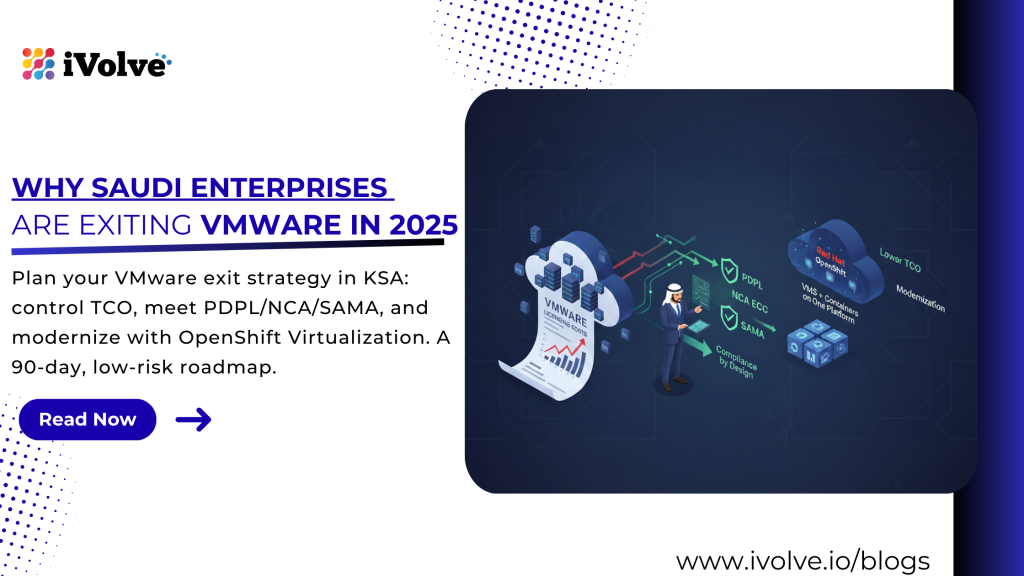
TL;DR
- Why now: Licensing/program shifts and 2025 support deadlines make VMware pricey and risky to renew; boards want cost control and leverage.
- KSA-first mandate: PDPL, NCA ECC, and (for banks) SAMA push in-Kingdom data residency, encryption, RBAC/SSO, centralized logging/SIEM, and auditable DR drills.
- Migration playbook (90–180 days): Discovery & TCO → non-prod pilot (10–20 VMs) → wave-based cutovers → decommission/optimize.
- Governance by design: Maintain evidence packs (IAM policies, KMS, SIEM logs, DR reports, PDPL data maps) to prove compliance continuously.
- Business outcomes: Lower, more predictable costs; reduced vendor risk; faster modernization to containers and AI; cleaner audit posture.
- Next move: Stand up a KSA-resident landing zone and run the pilot now—then scale in waves to exit 2025 with a simpler, compliant, and future-ready platform.
Executive Summary
In 2025, a perfect storm is brewing in Saudi Arabia’s enterprise IT landscape. For years, VMware has been the backbone of infrastructure for many of the Kingdom’s largest organizations. It was a de facto standard. But now, that foundation is cracking under the weight of new business models and the pressing demands of local governance.
For CIOs and IT leaders, the question is no longer “if” they will move from VMware, but “when” and “how.” The imperative for a VMware exit strategy in KSA is clear: control costs, mitigate risk, and build a platform that aligns with Saudi Arabia’s national and regulatory vision, from PDPL data residency in Saudi Arabia to NCA ECC compliance in the cloud.
This guide explains why Vmware exits Strategy are accelerating and how to plan a KSA-ready migration including discovery, non-prod pilots, wave-based cutovers, DR drills, and audit-ready evidence packs.
Key Takeaways:
- Immediate action required: vSphere 7 support ends October 2025
- Cost optimization: Alternative platforms offer 30-50% TCO reduction
- Compliance mandate: PDPL and NCA ECC require in-Kingdom data residency
- Future-ready platforms: Unified VM + container management accelerates modernization

What Changed in 2024–2025
- Pricing & licensing shifts. After the Broadcom acquisition, VMware simplified portfolios, moved hard to subscriptions, and made controversial licensing adjustments that many customers and partners consider cost-inflating. European cloud groups and partners have publicly pushed back on price hikes, bundling, and restrictive terms.
- Core-based minimums and program friction. Industry reporting highlighted increased minimum core purchases (and penalties for late renewals), intensifying budget pressure for enterprises with CPU-dense hosts.
- Partner ecosystem shake-ups. Restructuring of the Cloud Service Provider program — including an invite-only model — has created uncertainty for customers served by smaller MSPs and regional hosts, raising renewal and support risks.
- Deadline pressure. vSphere 7 and vSAN 7 End of General Support moved to October 2, 2025. That extension helped, but the runway is still short for large estates with change control and compliance steps.
Together, these drivers make a compelling case to assess VMware exit strategy KSA options now — before contract cliffs and support deadlines force rushed decisions.
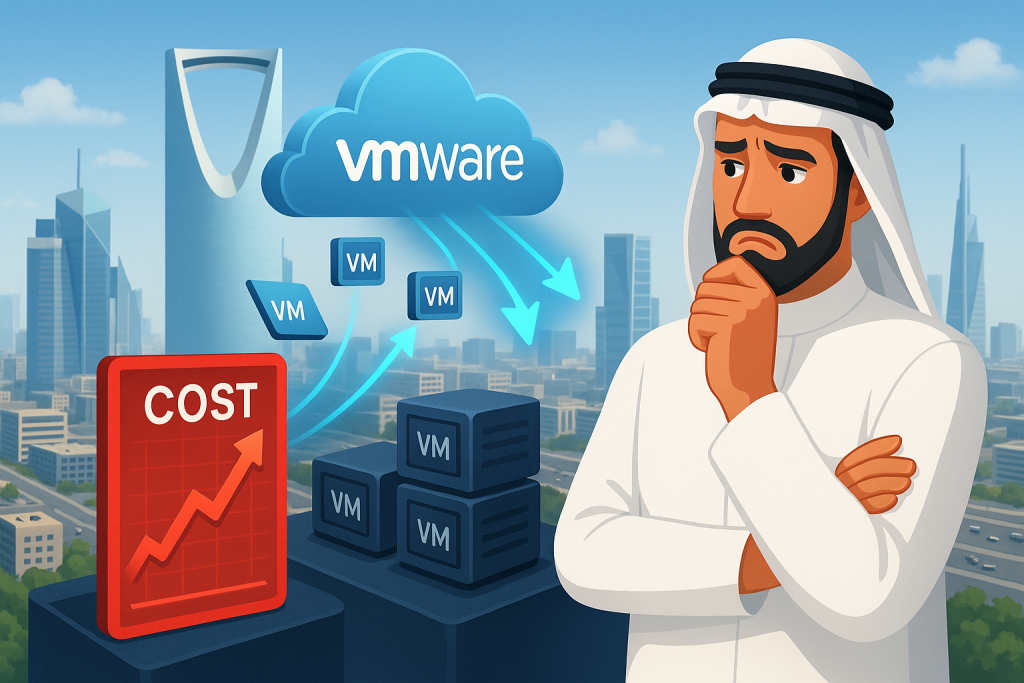
Why Saudi Enterprises are Exiting: 8 Business Drivers
- TCO visibility and control
Subscription shifts and core minimums complicate predictability. Many teams can reduce TCO by moving to platforms with transparent, host-based or cluster-based economics and fewer add-on SKUs. - Compliance & data residency by design
PDPL requires strong controls for processing personal data and sets conditions for cross-border transfers; many organizations now prefer in-Kingdom processing to simplify compliance and stakeholder trust. NCA ECC adds mandatory cybersecurity controls; SAMA sets sector-specific requirements for financial services. Modern alternatives let you architect KSA-resident stacks with built-in encryption, RBAC/SSO, logging/SIEM, and audit trails. - Operational risk reduction
Program upheaval among partners (and potential renewal churn) is a real risk. Standardizing on open ecosystems and widely adopted stacks reduces single-vendor exposure. - Kubernetes-first modernization
Most new apps target containers and microservices. Running legacy VMs alongside containers on one platform simplifies operations and speeds modernization. - Platform consolidation
Tool sprawl is expensive. Alternatives that natively host VMs + containers and integrate software-defined storage, networking, and security can collapse layers and licensing. - CapEx→OpEx flexibility
Many KSA enterprises want elastic consumption (on-prem or hosted in KSA) without rigid, multi-year lock-ins. - DR and cyber-resilience
Audit-ready DR drills, immutable backups, and full-stack logging are easier to standardize on modern platforms aligned to ECC domains and SAMA controls. - Future leverage
Open standards and portable workloads regain negotiating power and multi-cloud choice.

Practical Alternatives to VMware in Saudi Arabia
Your target state should balance three things:
(1) compliance & residency in KSA
(2) VM + container coexistence for 3–5 years
(3) simpler economics. Here are mainstream options teams are adopting
1) Red Hat OpenShift Virtualization (Kubernetes + VMs on one platform)
- What it is: An add-on to OpenShift that lets you run and manage virtual machines alongside containers using Kubernetes APIs and CRDs. This unifies operations, security, networking, and observability, a strong fit for phased modernization.
-
Why KSA teams like it:
- Single control plane for VMs and containers (one RBAC, one CI/CD/security pipeline).
- Smooth VMware to OpenShift migration with migration waves and app-by-app refactoring later.
- Strong ecosystem for backup (e.g., CSI snapshots), policy, and GitOps.
- Compliance angle: Build KSA-resident clusters with encryption at rest/in transit, centralized logging to SIEM, and evidence packs aligned to PDPL/NCA ECC/SAMA.
2) OpenStack/KVM (private cloud control plane)
- What it is: An open IaaS platform widely used to run KVM hypervisors at scale; KVM is the default hypervisor for OpenStack Compute (Nova).
- Why KSA teams like it:
- Open, proven, and cost-efficient; strong isolation for regulated workloads.
- Mature SDN/storage options and integration with identity providers.
- Compliance angle: On-prem or KSA-hosted OpenStack clouds make data residency straightforward and map well to ECC domains (asset management, access control, logging).
3) Nutanix AHV (hyperconverged virtualization)
- What it is: A modern, enterprise virtualization stack integrated with Nutanix HCI — supports VMs, with options for containers, robust HA, and lifecycle management.
- Why KSA teams like it:
- Simplified ops, competitive licensing, strong VDI/DB performance references.
- Practical for “like-for-like” VM migrations where Kubernetes isn’t step one.
Tip: Many enterprises mix OpenShift Virtualization for app modernization with OpenStack/KVM or AHV for stable VM estates, standardizing on shared IAM (SSO), SIEM, and backup so audit evidence is centralized.
A KSA-ready VMware Exit Blueprint (90–180 days, wave-based)
Goal: De-risk fast, meet compliance, and create a platform that supports both legacy VMs and cloud-native.
Phase 1 — Strategy, Discovery & Assessment (2–4 weeks)
- Inventory & map: Pull a definitive CMDB: VMs, owners, OS, CPUs/cores, memory, storage, network, inter-app flows, DR class, and RTO/RPO.
- Classify data under PDPL: Identify personal data, special categories, and cross-border dependencies. Define lawful bases and retention; decide which data must remain in KSA.
- Security baseline (NCA ECC): Gap-assess access controls, network segmentation, hardening, logging/monitoring, incident response, and backup/restore posture.
- TCO model: Compare “as-is” VMware (subscription, core minimums, support) vs. target platforms (software, hardware, support, skills, migration). Include one-time costs (training, pilots, DR tests) and run-rate OPEX.
- Target architecture: Choose OpenShift Virtualization, OpenStack/KVM, Nutanix AHV, or a hybrid. Define tenancy, encryption/KMS, logging to SIEM, and SSO.
Phase 2 — Non-Production Pilot (3–6 weeks)
- Scope: 10–20 representative VMs (web+app+DB), plus an integration or two.
- Build landing zone:
- OpenShift Virtualization: Install operator, define VM templates, storage classes, networks; validate VM import and day-2 ops.
- OpenStack/KVM or AHV: Stand up cluster, HA, storage pools, virtual networks, and backups.
- Controls & evidence:
- RBAC/SSO mapped to job roles (least privilege).
- Logging to SIEM (admin actions, auth, network, workload logs).
- DR drill for pilot apps; record RTO/RPO and test reports for auditors (ECC/SAMA).
- Success criteria: Performance within 5–10% of baseline, backup/restore OK, DR validated, zero P1 incidents.
Phase 3 — Scale in Waves (6–12+ weeks)
- Wave design: Group workloads by business capability, risk, and inter-dependencies (e.g., Wave 1: stateless web; Wave 2: app tiers; Wave 3: DB; Wave 4: heavy stateful).
- Cutover runbook: Freeze, snapshot, replicate, cut over, verify, and decommission in controlled windows.
- Guardrails:
- Change management approvals (CAB) and back-out plans.
- Continuous penetration testing or hardening checks in higher-risk segments.
- Evidence pack for each wave (configs, approvals, test logs, post-cutover health).
- Optimization: Right-size resources; move shared services (DNS, LDAP/AD, monitoring) last.
Phase 4 — Decommission & Optimize (2–4 weeks)
- Securely retire old clusters; document sanitization.
- License clean-down to stop paying for stranded capacity.
- Modernize: Begin refactoring candidates to containers on OpenShift (CI/CD, service mesh), while stable VMs continue where they fit best.

Governance & Compliance Checklist (KSA)
Embed these controls from day one and capture auditable evidence:
- PDPL
- Data mapping (what personal data, where processed).
- Cross-border transfer assessments and SCCs (if applicable).
- Data subject rights processes (access, rectification, erasure).
- NCA ECC (2024 update)
- Access control & IAM (SSO, MFA, role-based policies).
- Asset management, configuration baselines, vulnerability mgmt.
- Centralized logging, monitoring, and incident response.
- Backup/restore and DR drills with measured RTO/RPO.
- SAMA (for financial services)
- Governance, risk, and control implementation aligned to the Cybersecurity Framework; periodic self-assessments and continuous compliance.
Evidence packs to maintain: Architecture diagrams; RBAC/KMS configs; SIEM log exports; DR drill reports; change records; penetration test findings; DPA/DTIA for any data sharing.
Cost Model: How to Size the Business Case
Inputs to model:
- Licensing & support (current): VMware subscription SKUs, minimum core counts, S&S, plus MSP margins.
- Target platform: OpenShift/OVirt components (for OpenShift Virtualization), OpenStack/KVM or AHV SW, support tiers, and required hardware refresh.
- One-time migration: Discovery tools, pilots, migration factory, DR testing, training.
- Run & operate: Headcount, patching, monitoring, backup/snapshot, SIEM storage, platform upgrades.
- Risk credits: Value of avoiding renewal cliffs, partner uncertainty, and unsupported vSphere versions.
Output: A 3- to 5-year TCO/ROI view that usually favors consolidation (VMs + containers) and open platforms, especially when you include compliance overhead and DR cadence.
Quick Decision Tree
- Do you have a 2025 support or renewal cliff?
- Yes: Prioritize a non-prod pilot immediately; lock a landing zone this quarter.
- No: Still model options; the best deals require time.
- Are you modernizing apps to containers?
- Yes: OpenShift Virtualization gives a single platform for VMs now and containers tomorrow.
- No (VM-centric): Consider AHV or OpenStack/KVM for like-for-like migration and better economics.
- Strict residency or sector rules?
- Yes: Prefer KSA-resident platforms; ensure logs, backups, and keys also stay in KSA. Align to PDPL/ECC/SAMA controls.
- Mixed: You can split tiers of sensitive data in KSA, non-sensitive in approved regions.
The Bottom Line for 2025
Saudi enterprises are exiting VMware to reduce uncertainty, simplify costs, and modernize on platforms that meet PDPL, NCA ECC, and SAMA expectations while keeping data in the Kingdom. Whether you standardize on OpenShift Virtualization, OpenStack/KVM, Nutanix AHV, or a hybrid, the winning playbook is consistent:
- Decide early, pilot fast, prove DR and security.
- Consolidate platforms (VMs + containers) to cut TCO and complexity.
- Operationalize compliance — encryption, RBAC/SSO, logging/SIEM, change management, DR drills, and audit-ready evidence.
Conclusion
For Saudi enterprises, 2025 is the moment to turn uncertainty into advantage. A thoughtful VMware exit strategy in KSA isn’t just about lowering TCO; it’s about regaining control, accelerating modernization, and proving governance with PDPL-aligned data residency, NCA ECC controls, and (where relevant) SAMA expectations. The winning pattern is clear: stand up a KSA-resident landing zone, validate a non-prod pilot, then execute wave-based cutovers while unifying RBAC/SSO, encryption, logging/SIEM, backups, and DR drills. Whether you standardize on OpenShift Virtualization, OpenStack/KVM, Nutanix AHV, or a hybrid, consolidating VMs + containers on fewer, open platforms reduces risk and unlocks agility for the next three to five years. Start now, capture evidence as you migrate, and you’ll exit 2025 with a simpler platform, predictable costs, and a stronger compliance posture—ready for what’s next.

FAQs (for CIOs and Heads of Platforms)
Q1. Is this just about cost?
A. No. Cost matters, but the biggest drivers are control, compliance, and risk. The partner program changes and licensing friction increase operational risk; moving to open, KSA resident platforms tightens governance and future-proofs the stack.
Q2. Why not wait until 2026?
A. If you’re on vSphere 7, waiting invites a compressed timeline and potential support exposure. Pilots, DR drills, and change windows take months — start now.
Q3. Can we keep some VMware?
A. Absolutely. Many enterprises run a dual-track: keep VMware where it’s mission-critical and stable, but shift growth workloads to OpenShift Virtualization, OpenStack/KVM, or AHV. The key is unifying IAM, logging/SIEM, and backup to simplify audits.
Q4. What’s the fastest low-risk path?
A. Stand up a non-prod landing zone (in KSA), migrate 10–20 representative VMs, validate DR and compliance evidence, then execute wave-based cutovers aligned to business calendars.
Q5. How do we prove compliance?
A. Build evidence packs as you go: access policies, encryption configs, SIEM logs, DR test reports, and PDPL data maps. ECC and SAMA expect documented, repeatable controls and periodic assessments.


Pingback: VMware to OpenShift Migration: Step-by-Step Guide
Pingback: VMware Alternatives in 2025: Best Picks, Costs & Migration
Pingback: Understanding OpenShift Virtualization (KubeVirt): Key Concepts & Best Practices